Tuesday, March 15, 2011

The Hardest, Most Noteworthy Achievement I Have Ever Achieved

     Here on Cartridge Gamer, I try to deviate from writing about current-gen games as much as possible. However, this is kind of retro in a sense, but with a modern twist. My purchase of Sonic's Ultimate Genesis Collection for my XBOX 360 that I wrote about back in January came with a ROM of Sonic 3D Blast. If you're even a casual fan of Sonic the Hedgehog, you've probably heard of this game, and you've already renewed your restraining order on Sonic Team for this catastrophe.
     Sega had a great idea with Sonic's Ultimate Genesis Collection in that it incorporates achievements into these old games to add a fresh challenge to the package. I like this, a lot. Even though the achievements are limited to one per game, and are obtainable within the first 5 minutes of playing, it's a welcome addition for an achievement whore such as myself.
     But when there's an achievement worth 15G's, and it's for rescuing 20 Flickies in Sonic 3D Blast, and you know full well what you're about to do, you have a serious problem. If you go to thesaurus.com, and you look at each synonym for masochism, you will find every word that went through my mind while I questioned the sanity and the intentions of Sonic Team when developing this game, and myself playing this game.
     Sonic 3D Blast is not a game I am unfamiliar with. When I was twelve-years-old, I had my dad pick me up a copy of Sonic Mega Collection for the GameCube, and I enjoyed everything except for Sonic 3D Blast. Even back then I knew that it played dreadfully, with Sonic drunkenly running around, building up so much momentum that he would dash into an enemy who's hit-box covered half the platform. Not only were the physics thoroughly nonsensical, but the fact that this game was developed with a D-pad as it's directional input was but the frosting for this cake of destruction.
     You see, the 3D in the title is referencing the game's semi-top down, isometric view. While I'm sure this was a technological achievement for Sega, pre-rendered computer graphics don't have to be applied to a 3D platforming title developed for a console that simply wasn't prepared for the genre. A four-way D-pad doesn't make sense for this type of game because it doesn't supply the precision of touch that only a joystick can. With a joystick, you can apply a little pressure to make your character tip-toe, or a lot of pressure to make him run the only way Sonic knows how. Rareware knew this, that's why the Donkey Kong Country series is comprised of 2D platformers.
     Because this was a straight port, it didn't matter that I was using the joystick on my 360 controller, because the only thing Sonic was going to do was run. He ran into enemies, off of ledges, and into spikes, and there was not a damn thing I could do about it, all because he couldn't tip-toe. I had to play through several levels to collect all 20 Flickies, which are little birds that have been cruelly trapped inside of robots by the heinous Dr. Robotnik. Through this jaunt I took several pictures of my television to chronicle my frustration.
      What you see to the left is the obligatory floating, moving platform in every platformer to date. The five little boxes on the bottom right are my collected Flickies and my missing ones. At this point, I was about to rescue my 20th Flickie. I was thrilled. Not too fast, me- aren't you forgetting something? Oh, that's right: even gently touching the joystick will make Sonic fly past the platform, because Sonic Team sent Doc Brown and Marty McFly to the future to make sure I wouldn't run out of material for Cartridge Gamer, and developed the single most irritating, teeth-gnashing-iest portion of any game I've ever played. You can't understand the pain I felt from the half hour it took me to complete this jump, because I kept missing the mark and shooting past the platform and having to run back up this mountain of cruelty because this was a moving platform. It only made matters worse. This tiny, insignificant platform in a seemingly enormous adventure game had me in hysterics. Never again, Sonic Team.
      I think the final hammer-to-the-cranium experience I had, upon finally collecting the 20th godforsaken Flickie, was the end of level scoring. Just like every other Sonic game, it gives you various letter grades on the time it took you, and the rings you got, among other things. Unfortunately, I failed to document this screen with a photo, but it said "Time Taken: Too Long."
      ...Seriously, Sega? I'm sorry I couldn't finish the level as fast as you spat the development of this game out onto wasted disk space, reminding every hardcore Sonic fanatic why they hate themselves. I don't even like Sonic that much, and I still cried myself to sleep. But I got that 15G's, though, so I guess it was worth it.
    

Friday, January 21, 2011

Alien Storm (1991)

     I recently purchased Sonic's Genesis Collection for my XBOX 360 for ten dollars. This disc has 40 games on it, and I'm most pleased. You see, I've never owned a Sega console, so there are probably hundreds of games that have fallen under my love-radar, and this collection was quite a find. Especially for someone who doesn't really want to own a Genesis.
     The games featured are pretty predictable; of course, it has your Sonic's, your Streets of Rage trilogy, and then it has some I wasn't expecting, some I've never heard of. So, I began playing in alphabetical order, and Alex Kidd was the first to play. I think I might've gotten to level 2 before politely declining to go any further, for the rage building up inside of me was a little overwhelming.  
     ...And then, there was Alien Storm.  Alien Storm came out in 1991. This means it's a beat-'em-up, with radical music and tubular visuals, but really, it just seems like every other beat-'em that preceded it. This game is clearly emphasizing everything that the '90s embodied, and it's awesome. There's the obligatory tough guy, the girl who probably should've worn more appropriate clothing to an alien invasion, and the third wheel; in this case, a robot. They all handle exactly the same, so it's mostly for aesthetic preferences.  I don't know about you, but I usually like to play with half of an erection, so I chose the robot.
     Apparently, there's an alien invasion, and I'm not sure where our heroes come into place in that respect. All I know is that they somehow equipped themselves with lasers, rocket launchers, flamethrowers, and malignant narcissism, as evidenced by the box art. In other words, everything one needs to make a game from the '90s, and everything awesome. 
     The graphics are pretty good, but I feel like I'm playing a science-fiction Streets of Rage. Except the first Streets of Rage handled terribly, and Alien Storm actually plays decently. I use the word "decently" because there were times when I felt I was playing a 2D fighter à la Mighty Morphin' Power Rangers: the Fighting Edition. This isn't necessarily a bad thing, but it is when you play fighting games like me. 
     Let me provide an explanation to this analogy: your weapon in Alien Storm requires energy, displayed in a bar underneath your health. Using your weapon takes up energy, and energy is a limited resource in the Alien Storm world. Therefore, it's best to find an alternative way to curb-stomp aliens rather than blindly firing your weapon, as the depth between where I was in relation to the alien was questionable. The only alternative I found was to throw the robot forward with a roll and hit the attack button, but the accuracy of this method was terrible. Thus, I was left in this limbo of button-mashing and rotating the d-pad. If I was playing the Fighting Edition this would've been awesome, but it doesn't really help here, and made killing aliens a little more tedious than it should have been. It's completely possible that my lack of skill prevented me from not playing like an idiot. 
     Alien Storm taught me that if an alien is a different color than the alien that came before it, it will undoubtedly kick more ass and be harder to kill. I giggled on several occasions, because after introducing some pink slugs, they unleashed the slightly-more-pink slugs, which of course kicked more ass. The giggling happened again when they reverted back to the regular pink slugs afterward, which in regards to level design makes no sense. Overall, the designs of the aliens were pretty interesting, but nothing out of the ordinary for a '90s game. 
     One thing that I thought was pretty cool were the end-of-level challenges. These challenges branched away from the genre and provided some first-person shooting gallery action, in which your character completely tears up an area with their gun in search of hiding aliens. The amount of destruction to the area in such a small amount of time was beautiful, as literally every object was destroyable or burnable. That made me sound a little psychotic.
     Alien Storm was pretty good. There were a few other modes I didn't feel compelled to check out, and I got to level 3 of 6. It was challenging, but after my first death I didn't bother trying again. I've already beaten Streets of Rage, so I pretty much beat this game too. 

Buy Sonic's Genesis Collection on Amazon, because buying the actual cartridge seems a little silly at this point:

Monday, January 10, 2011

Mario Tennis (2000)

When I was a kid, games were reserved for special occasions, or were the end result for an unreasonable amount of chores. The only instance that I was given a game after doing chores resulted in Nicktoons Racing for the Game Boy Color.    
     Yeah.
     To avoid anything like that ever happening again, renting games until Christmas or my birthday was just fine. Not so with Mario Tennis. I remember looking up the website of Mario Tennis, getting giddy with it's imminent release of the summer of 2000. I just tried to remember why I was getting giddy about a tennis game, because not only had I never played an actual game of tennis at the time, but I also loathed sports. I think the answer was, and I shit you not, that I thought it was a direct sequel to Super Mario 64.
     ...You have to understand that I was 10 at the time, and the only game with Mario I ever had was Super Mario 64. So, to a boy that thought that this was a sequel to Super Mario 64, coupled with the fact that Super Mario 64 is essentially one of the greatest, most revolutionary games of all time (my 10-year-old self thought so too), one can understand my excitement. Unfortunately, Mario Tennis was released a few weeks after my birthday, forever damning it to rental status in my collection.
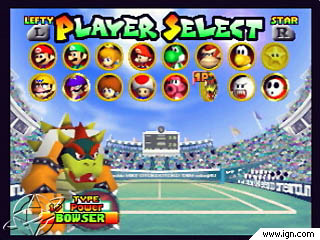
     And I rented that game to no end. Initially surprised at the steps back that the developers apparently had taken in Super Mario 64, I took a minute to try to take everything in. At the Player Select screen, I questioned why they would call it "Mario Tennis" if you could play as someone other than Mario. I probably asked this out loud, because I had no friends.
 Speaking of which, why is Bowser in a friendly game of tennis with Mario and Peach? Isn't that taboo?
I mean, the guy just kidnapped Peach, like, four years prior.

    Fan-banter aside, once I really sunk my teeth into the game, absolutely nothing else mattered. I deducted that Mario Tennis was the embodiment of fun, which was odd because it was a sports game. I think the key was in it's accessibility; within a few minutes of picking up the controller, I was already a master of technique. You see, the only real buttons you need are A and B, coupled with the joystick of course. 
   Looking back, its incredible that they only provided two buttons into the control scheme, but there's so much depth to be discerned between playing casually and playing like a boss. Both buttons provided different methods of hitting the tennis ball, and each could be held down for a more powerful shot. You could also hold both of them down for a third type of shot! These shots were all manipulated by pushing the joystick in different directions, which is where the real challenge was, because you had to be mindful that you were controlling the direction where you were running and the direction you planned to hit the ball in. It was a simultaneous effort that I had a hard time with at first. 
     Whatever happened to Mario Tennis, you ask? Unfortunately, nothing. It got lost by the wave of other rentals that summer, the likes of which were Banjo-Tooie and Majora's Mask. By the time Christmas rolled around, it was already too late; I opted for more PlayStation games and Super Smash Bros., with Mario Tennis sorely forgotten.
     However, I picked up Mario Tennis a few days prior to this write-up to re-indulge myself in it's glory, and its amazing the extent that Camelot, the game's developer, went with just how different each character class controls. I started by acquainting myself with Luigi, as my tastes have developed and been refined in the last 10 years, and obviously Luigi is superior to Mario. What I said earlier about it's accessibility couldn't have been more true; within minutes, it was like the last ten years weren't Tennis-less, like I had been playing for ages. My girlfriend, who had never played a tennis game in her life, joined me in some doubles games as well. Of course, there was a learning curve at first, but the rate at which she picked it up was astounding. She even noticed patterns in the game's AI, and began curb-stomping them accordingly. The fact that someone who isn't much of a seasoned gamer, yet was almost at the same level as me says a lot about how much fun the game is.
    What's interesting to note is that as a kid, I didn't understand that each character controlled differently; I stuck with Mario for the majority of my rental so I could maintain that Super Mario 64 authenticity. Really, I thought it boiled down to Nintendo catering to people's different favorite characters and didn't add any layer of technique to the game itself. However, every two or three characters are coupled into different classes of technique, and if you spend a lot of time with one character, switching to another character brings a very noticeable change. For instance, Luigi is more of a balanced character, perfect for beginners. But when I switched to Donkey Kong, his girth made him slower than Luigi, but his powerful hits were ridiculous. At one point, I won an entire game just by serving. On the other hand, Peach was terrible and I didn't win a single game with her. Regardless, there's a different class for everyone, and I'm pretty positive most will be pleased with the added layer of depth in this as well.
     The music isn't anything to write home about. It's mostly sports-y, and I was too concerned with the white-knuckled tension of every game anyway to really notice it. On the Donkey Kong-themed course, it did have a nice medley of the 8-bit theme from the first game, but that's about it. 
     I can't recommend Mario Tennis enough, if you haven't noticed. The controls are superb, the graphics are meh, and the fun is through the roof. I can't believe I just wrote that.
I bought Mario Tennis for around 8 bucks, and you can too on Amazon.com:

Sunday, January 2, 2011

Conker's Pocket Tales (1999)

     It would be a grave mistake to confuse Conker's Pocket Tales with Rareware's follow up Conker's Bad Fur Day, because Bad Fur Day is actually a good game. Bad Fur Day plays well, has wonderful voice over work, and gorgeous graphics. Pocket Tales has none of these things.
     To be honest, the Game Boy only had a handful of good games in it's massive library of rubbish, and I would come to Rareware's defense to say that porting a massive action-adventure that isn't a side-scroller probably isn't a good idea. I would say that, but I can't, because Rare did it anyway.
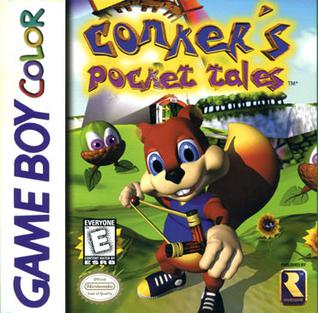
     I didn't come across Pocket Tales until the late summer of 2010, though I was aware it existed when I was 9-years-old. I didn't even want it when I was naive enough to think Toy Story 2 for the Game Boy was a good game. Pocket Tales, what with it's dark, uninviting color palettes and it's top-down view had nothing in it's favor of tricking a child into wanting it. Now, I paid eighteen dollars for this game. Eighteen dollars. I'm a twenty-year-old man. While it's possible that my state of feeling swindled by the box art could explain my animosity towards this game, as I was expecting something both cuddly and sassy (slingshot equals sass). Imagine my surprise when all I got was shit.
     As a side note, shouldn't the prequel to an amazing platformer be at least half as good as it's successor? I would like to think that bad things usually don't get greenlighted for a sequel, but the Crash Bandicoot series leaves me corrected. I digress.
     In Pocket Tales, Conker's girlfriend Berri gets kidnapped by a gigantic acorn. I guess the gigantic acorn really felt like being a dick, because as if kidnapping Conker's girlfriend wasn't enough, the acorn goes ahead and steals all of Conker's birthday presents too because it's Conker's fucking birthday. 

But I mean, seriously, look at this shit.  I don't think his birthday could 
have been any worse, really.

      After the "cut scene" (I dare you), two mind-numbingly frustrating tasks are presented to the player, who at this point is probably reconsidering their dabble into masochism. Conker obviously has to find Berri, but he also has to find any and all presents in the area in order to move on. And this has to be done while looking at this:

Ouch.

     Whenever I buy an old game, it's a self-proclaimed promise of mine to play the game on it's intended format, in this case the Game Boy Color. Do you remember what trying to see what you were doing on the Game Boy Color was like? Squinting my eyes in a whirlwind of blindness and depression now added a third task at hand: attempting to make any type of progress whatsoever towards the two aforementioned tasks, because I can't fucking see what is happening. It is now at the five minute mark since I have turned the game on, and it is now when I must turn the game off before there is any permanent damage done to me or those around me. Eighteen dollars should warrant a good time, and I now know it does not.
     There is now no question as to why Conker became an alcoholic in Bad Fur Day.

Monday, December 27, 2010

Super Mario Bros. (1986)

     Everyone knows Mario, and most everyone is familiar with the heralded Super Mario Bros. So much so, that there's almost no need for an introduction. This year marks the 25th anniversary of Mario's hit on the Famicom, and it feels a little wrong not to celebrate with the rest of the world.
     Super Mario Bros., in it's no-save, tough-as-nails glory, really hasn't phased me as much as it should have. I enjoy it to an extent, but to this day I can only get past world 8-3. I've never saved Peach, nor have I felt the burning desire to try hard enough to get past that. 
     And yet, I own almost every North American release of the game, including the Game Boy Advance re-release, which in comparison to Super Mario Bros. Deluxe for the Game Boy Color was ironically inferior. What has kept not only myself, but millions of other gamers coming back to this 25-year-old game? For me, it couldn't possibly be nostalgia; I didn't grow up with the NES, and my first Mario game was Super Mario 64. 
     No, it would be wrong to chalk up the reason to something as labeled, as ordinary as nostalgia. What we have here can't be expressed in words. Super Mario Bros. has the power to turn children into gamers. When one picks up the controller, they just know what has to be done. It is quite clear in my memory that I had no question of how to play the game, and in a generation where tutorials are long, game play complexities high, and casuals be damned, Super Mario Bros offers no hand-holding. There is no clear explanation as to how to play the game, aside from the manual of course, and yet everyone who picks this game up for the first time knows that they must make Mario move to the right. Of course, there's much more to it than that- I can't make it to the final level, but I digress. To me, this is not only refreshing, but arguably what saved the video game industry.
     When viewed literally, like most games, Super Mario Bros. could have been a failure. Playing as a 40-something plumber shouldn't be fun, yet it was revolutionary. The vibrant, colorful worlds filled with mushrooms and turtles is inviting, and instantly accepted. There is no way to explain how Mario-creator Shigeru Miyamoto managed to single-handedly revive a dying market and revolutionize the way we play games, but he did. 
     The gameplay was flawless; I'm trying to think of anything I can say that could criticize it, but it is impossible. The music was flawless; with just three different tracks, Super Mario Bros.' music has such resonance in our culture today, with the main track subsequently being referenced in every Mario game in some form, and in the media. Humming the tune will most likely generate a feeling of familiarity in the minds of those around you who hear it. The only thing I could criticize is it's difficulty towards the end of the game, but I'm stopped by the fact that it's probably just my own lack of skill. 
     Seemingly the only way to explain the unquestionable fun of Super Mario Bros. would be to call it a miracle- you don't know how it happened, or why, but you accept it and appreciate it for what it is. There are better games to play, sure, but would those games exist had it not been for Super Mario Bros.? Probably not. Happy 25th, Mario.
One more copy of the same game shouldn't hurt, so why not really impress your friends, and get a copy of Super Mario Bros. for the Famicom off of eBay:

Monday, November 8, 2010

UmJammer Lammy (1999)

      The PlayStation fell ill to terrible, terrible games. Well, maybe it was just my PlayStation. I received mine pretty late into it's life cycle, and looking back on my collection, I didn't have any of the killer-apps that my friends fondly reminisce about. I never had a game developed or published by Squaresoft, not even a Final Fantasy. I never had a Crash Bandicoot. I never even had Metal Gear Solid. It could have been my age, or my ignorance, but I had games like Streak: Hoverboard Racing, A Bug's Life, Rugrats: the Search for Reptar, and Ninja: Shadow of Darkness. That just scratches the surface of filth. I had the first Tomb Raider, but even that was a port of a Sega Saturn game. Yet somehow, within this terrible pile of coasters, I enjoyed myself at the time. Then I got UmJammer Lammy. This game would not only be my first foray into the rhythm genre of gaming, but a massive wake up call to what I should be playing on my PlayStation: good games.
      Lammy opens as a Saturday morning cartoon, and keeps up that motif through the whole game. It even has the cliche catchphrases one would expect from a 90's cartoon protagonist. The overall challenge is to get Lammy to her band's gig on time, with the meat of the game leading you to that grand finale. Each challenge in the game is it's own little episode, which contains a brief introduction to the problem at hand, a song that you play through that solves said problem, and the outcome.
     Now, as a whole, UmJammer Lammy is completely ridiculous, yet this somehow not only works, but makes the game stand out with flying colors. All of the characters are represented by paper cutouts à la Paper Mario, but this fact is emphasized in the way they bend and move. There's absolutely no continuity as for what the characters are: they range from animals to aliens and vegetables. The songs themselves are fantastic, if not for their actual composition, then for how off-the-wall they are. Lammy has the uncanny ability to turn anything into a guitar to solve the townsfolk's problems; at one point, this lets her play a baby. I love everything about it. I think especially now, with the emphasis on realism in gaming, Lammy is refreshing and a necessary experience to remind gamers of what was so captivating about video games in the first place.
     Specifically for this review, I went back and played through the whole game- yes, the whole game. In one sitting. It's extremely short if your rhythmically gifted, but even taking that into consideration some of the challenges are pretty tough. Needless to say, it was a blast. Even if you haven't played the game, it is absolutely necessary to download the original soundtrack. I laughed. I cried. Well, not really.


Thursday, October 21, 2010

Dragon Ball GT: Final Bout (1997)

      As mentioned prior, I love manga artist Akira Toriyama. Something about Dragon Ball Z's absurdly muscled fighters gently levitating in the air and screaming for half-an-hour has had me hooked for 12 years now. With continual re-releases and new toy sets based on a long-dead anime/manga, it's safe to say that Z's allure has captured the imagination and closet wrestler of us all. 
      And yet, while Dragon Ball was still a relevant series, there was not one good fighting game based on it. Beginning with the Famicom, every release had the potential to take all that was great about Dragon Ball's ridiculous fights and put them in the control of countless rabid fans with the one requirement of being a good game. That's all the fans wanted. Released for the PlayStation, Bandai delivered Dragon Ball GT: Final Bout.
      Final Bout was released just as the Dragon Ball series was finishing up in Japan, thus Bandai had the series' entire back-catalog to form the game's roster. Just thinking of all the potential "what if?" fights I could have staged makes me giggle. Given the PlayStation's limited memory, Bandai should have been frugal with their character choices. Instead, they opted towards having multiple iterations of the same character.

     I count at least five Gokus and three Trunks.

      And that's not even the worst of it! Following the character selection is quite possibly the worst pre-match taunt accompanied by the worst voice actors the English localization team could have found. In Bandai's defense, Final Bout was released even before Dragon Ball Z hit Toonami in '98. Not only were they localizing a game who's namesake was based on a show that hadn't made it overseas, but there also wasn't an established English vocal cast yet. However, this doesn't account for the actual fights themselves to still have the prerecorded Japanese voice actors for every Kamehameha, Big Bang Attack and jump. This provides a nice touch of inauthenticity, as the males in the Japanese Z have quite high-pitched voices, especially when in contrast against the American dub. Perhaps they were lazy? Maybe they wanted the presentation to reflect how half-assed the actual game play was. 
      Oh God, here comes the game play. There is not one thing about the controls that I can praise. I remember subscribing to Beckett's Dragon Ball Z Collector magazine when I was twelve, and they had a section in one issue dedicated to importing Dragon Ball games. They had a review of Final Bout, and it closed with how badly the controls were. Picture this: there's a tiny man who's sole purpose is to tell the characters in Final Bout what action to perform. In order to do said action, you have to manually write out what the action is, hand it to the little man, who in turn runs down the entire length of the PlayStation controller chord, and delivers the action to the character on screen. Beckett's simile was so spot on, that I'm actually questioning whether or not they're on to something. Playing this game requires an unforgivable amount of dedication, investment, and patience; it's almost like having a relationship with the game, yet I've had relationships that have lasted shorter than how long it takes Vegeta to turn around. 
      This game is not worth the 30+ dollars it costs to find a copy of the original 1997 American release, and it's not worth the fifteen dollars I spent importing it when I was twelve. There was a re-release in 2004 when Dragon Ball GT actually started airing in America, so the value has naturally gone down, but why bother?